Showing posts with label potholes. Show all posts

Monday, July 9, 2018

Expat reentry…

“Charms to sooth a savage breast...”  1

On the 2018 summer solstice, I hiked the Sierras. This, to acclimate after a journey of 25,810 miles (41,536 km), from the southern to northern hemispheres, from winter to summer, from Zuma and Malema to Trump, and from KZN’s Midlands to CA’s unique combination of water, granite rocks, tall conifers, and open sky.

The day before the solstice, I departed my urban island-city home and, three hours later,  pitched a small tent about 40 miles south of Lake Tahoe. This region—Carson Pass, Silver Lake, Eldorado National Forest –has charms to sooth this jet-lagged traveler’s breast. (Note: breast, not beast. 1)

Looking from highway towards our destination where we planned to pitch
a small tent, relax, and prepare to hike.

Google Earth view 1: The spectacular body of water, San Francisco Bay, around my neighborhood.


Google Earth view 2: Swapping the beach for granite, conifers, water…open sky... and bears.

Potholes reprise

I was mistaken when I asserted in an earlier post that “Potholes” is not a sign seen in California. The context is different but potholes are alive and well –in our forests.   

Park rangers route hikers around a
vegetation restoration project.
  
We pitched out tent, secured all food and anything else with an enticing aroma into the campsite’s steel bear-proof locker.
Sign at Kit Carson campground.
 Then we went to explore potholes.


“To soften Rocks…”

Rocks of the Sierra Nevada are predominantly granite (metamorphic) formed during the Mesozoic Era (252 million to 66 million years ago (an era that included the planet’s greatest mass extinction—to date!—and an asteroid strike that killed off the dinosaurs). 
Granite. It sounds so sturdy and impenetrable. Yet even granite succumbs to time and weathering. Snow, water, weather, and the unremitting persistence of lichen weaken, crack, and erode granite. Lichen—“liken” or “lit-chen”— is a tenacious lifeform. To the layperson, it's a “simple slow-growing plant that typically forms a low crustlike, leaflike, or branching growth on rocks, walls, and trees.” To the scientifically minded, it’s a “a composite organism made up of a fungus, usually an ascomycete, that grows symbiotically with an alga or a cyanobacterium and characteristically forms a crustlike or branching growth on rocks or tree trunks.” To the ceramic artist, it’s inspiration. I try to reproduce a lichen-like effect on my clay garden sculptures. Photographs help this effort and, here, I add to my lichen album.


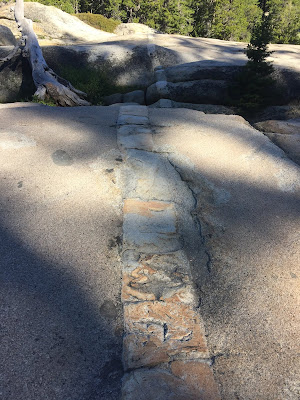
Further inspiration: sedimentary dykes in granite.


Open sky...or are those trees spewing clouds?


A Round Top solstice

Next day, June 21st, lunch and bathing suits packed, boots fitted, we headed to the foot of Round Top. I’ve never been there before and the view of the mountain through the trees—imposing, steep, and oh-so-distant—made it hard to imagine reaching it. The possibility of swimming in Lake Winnemucca, however, spurred me on.  

Destination: the foot of Round Top, (elev 10,400 feet).as seen in the distance through trees at about 8,000 feet. .


Getting closer...

At the 2018 mid-summer snow line….


The foot of Round Top: Lake Winnemucca.
On the banks of Lake Winnemucca, I pulled off my boots and socks and dipped a bare foot into the pristine water. Liquid snow! Immersing my bathing suit-clad body in that water—and surviving—seemed impossible. Instead, we sat on rocks among fallen trees, ate lunch, and greeted other hikers. For, yes, remarkably, at least eight hikers appeared–including a couple carrying an alert five-month-old in a Snuggly, followed by Buster the family dog. Turns out, there was an easier way to reach the lake from a closer trail head. Our hike route, however, was not difficult. I recommend it. 

Want to hike here? Search Google for directions to “Silver Lake East Campground, Ca” (we stayed in the Kit Carson or Silver Lake West Campground):

Highway 80 towards Sacramento. 
At Sacramento, take highway US-50 East.
US-50 E to Sly Park Rd in Pollock Pines.
Exit 60 from US-50 towards Sly Park Rd.
Right onto Sly Park Rd.
After 4.6 miles, go left on Mormon Emigrant Trail/Silver Lake Rd.
Left on Highway 88, then about 7 miles to Silver Lake West Campground (on the left, past the base of the lake). 

(All photos: © Susan Galleymore, June 21, 2018.)


In 1697, William Congreve wrote: 
     Musick has Charms to sooth a savage Breast, 
    To soften Rocks, or bend a knotted Oak. 

Read The Mourning Bride >>
Google indicates twice as many searchers seek “beast,” the incorrect version, than “breast.”

Sunday, June 3, 2018

Culture Shock Co-morbid with Bureaucratitis

Sign on road to Ingomankulu. Think of "potholes" as a metaphor.
(Photo: S. Galleymore, 2018.)

Welcome home!

Since 1989, I’ve made many two- to three-month-long forays “back home” to KZN from California. After my most recent foray unexpectedly extended from three to six months, I suffered a dose of culture shock co-morbid with a dizzying dose of, well, let’s call it bureaucratitis.
Culture shock is a state of critical assessment, psychological discomfort, even alienation that follows the initial euphoria a traveler experiences with immersion into exotic places, people, and things. It has an incubation period of three to four months in the unfamiliar or foreign place. It’s neither contagious nor terminal and the traveler slowly adjusts to and accepts her new circumstances.
Bureaucratitis is an acute state of anxiety, high blood pressure, and disorientation caused by reluctant visits to a local municipality or post office. Bureaucratitis worsens with an impending visit to the Department of Home Affairs.

I suffered my first bout of culture shock as a young adult after I left the spectacular rural countryside near the Valley of 1000 Hills that had been my home. A child with an adventurous spirit, I’d explored the Valley on horseback or (bare) foot and I knew the land within a five-mile radius of home like the back of my hand. It was my version of church, mosque, and temple.
The same adventurous spirit led me to explore urban San Francisco, albeit with maps—and good shoes—rather than rural skills and horses. Going from a dorp populated by fewer than five hundred to a conurbation of several million was challenging. It helped that I spoke English, a version of American.
My recent episode of culture shock co-morbid with bureaucratitis called for mental agility, physical flexibility, and several Grandpa Headache Powders. Episodes of this malady are not contagious either, but I plan to minimize visits to bureaucracies to prevent relapse. It’s been, as we say in America, “quite the ride.”

Urban and rural

In ultra-urban California, I “do” a laid-back version of the Californian “lifestyle”: commute, work, socialize, and drive, drive, drive. In KZN, I kick back, enjoy the birds and monkeys, complain about South African drivers (why do they ride my tailpipe?), the lack of on-demand wireless access and the repetitive TV shows (how do you stand it?) and shiver at the omnipresent undertone of violent mayhem.
Being bi- or multi-cultural can feel like a zero-sum game when Americans ask, “Where are you from?” and South Africans say, “You sound like a Yank.” I respond by adjusting my accent as needed. Over there, I pronounce battery “badder-ree,” and over here, “bat-tree”; an elevator becomes a lift; interesting goes from “inner-esting” to “in-tris-ting’: hawk from “haa-k” to “hork”; poop (as in dog poop) from “poo-p” or “poo” to “poep”; and Z, “zee” as in “zee-brah” becomes “zed” as in “zeb-rah.”
Right-handed, in California I eat hamburgers, French fries, hotdogs, tacos, and cookies with bare hands. For genteel meals, I place knife in right and fork in left hands to cut and manipulate food, lay knife across the top of the plate, and switch fork from left to right hands to eat.
In South Africa I eat mealies, marmite sarmies, and biscuits with bare hands and everything else with fork in left and knife in right hands.
There, I drive on the “wrong side” of the road (although four-, five-, and six-lane freeways make that concept obsolete), put “gas” instead of “petrol” into my car’s fuel tank, check under the “hood,” not the “bonnet,” and place groceries in the “trunk,” not the “boot.”
Here, I drive on the “right side” of the road…until potholes force me to veer to either side and the “shoulder.”

"bakkie" with bumper sticker: not drunk, just avoiding potholes
Potholes: ties that bind?
A bakkie spotted in a Pietermaritzburg parking lot.
(Photo: S. Galleymore, 2018.)

Potholes’ potential

The road sign displayed “Potholes.” That’s not a sign seen in California, so I suspected it meant something in isiZulu (as in “ama-po-tol-es”)…until I drove my car into one: ah ha!
Acclimated now, I veer hither and thither across roads avoiding potholes like every other driver. Yet, potholes offer enormous potential. Every South African, from drivers of the fanciest to the humblest vehicles, to passengers and pedestrians, knows a pothole. By presenting “nothing” where “something” ought to be, potholes highlight the conflict between rates-paying South Africans and rates-challenged municipalities. Potholes’ axel-grinding ubiquity forces equality across all political constituencies. And therein lies their power. Every South African would clamor to support the political party that disappeared the country’s potholes. Fix the potholes, run the country. (Don’t tell Juju!)
Recently, a local newspaper profiled two eighty-year-old pensioners, apparently gatvol with the status quo, who voluntarily filled potholes in their neighborhood, and at their own expense. Soon after, municipal road workers binged on partially filling potholes around town. In my neighborhood, workers went further. They filled potholes… resurfaced the road, both sides…painted lines, both sides …for five hundred meters. Then, finished and klaar, they left the rest of that road and all the other roads in the neighborhood as rough, torn, and dangerous as ever.
The cynical might see that as a metaphor, but I’m optimistic. Potholes communicate a positive message in our subliminal lingua franca: we’re all in this together.

Municipal woes

During my visit, my initial euphoria at being “back home,” my joyful exploration of what was new with people, places, and things, turned to despondency over the course of five visits to the local municipality to transfer one vehicle license. I quickly discovered my “spoiled American” persona. I’d drive home after each visit, shoulders knotted, belly clenched and heart thumping, and mutter, “Ag, I’m telling you, I’m gatvol with this bloody nonsense!”
America has its drawbacks—among them violence, exploitation, and over-consumption—yet it really is the “can do” country, with “can do” people born to the mantra “time is money.”  For example, ten years ago, California’s Department of Motor Vehicles (DMV) held the reputation as ultimate bureaucratic nightmare. Customers complained lines were “too long,” that it took “up to an hour” to “do anything,” and that trips to DMV meant time away from work (again, “time is money”). DMV responded. Nowadays, a customer sets an appointment, arrives on time, and is finished and klaar within twenty minutes. Or completes business on DMV’s reliable and easy to navigate website.
Over there, DMV taught customer-facing representatives that their job is focusing on customers (at least pretending) and presenting fast, efficient, courteous service.
Over here? Not so much.
Municipal customer-facing representatives appear less in-tris-ted in customers and efficiency and more in-tris-ted in morning tea break.

I’ve never licensed a vehicle in South Africa before, so I may have approached the task with heightened expectations. I assumed procedures would differ, but customer service is, well, basic….
Procedurally, both countries require drivers to hold a valid license and most (although far from all) drivers do. Everything else is different. Americans, for example, register while South Africans license vehicles.
My first surprise at KZN’s equivalent of DMV was shouting through thick glass to communicate with the customer-service rep. Then understanding new nomenclature: license vs. registration, license vs. license, etc. Then explaining, loudly, who I am, where I live, and why I use my passport as ID. (“I’ve been to Home Affairs four times and my ID card still hasn’t been issued.” People snickered knowingly but no one doubted.) At the end of my first visit, I requested a list of the documents needed. The representative wrote in the margin of my already-filled out RLV form, “proof of address”; that was it. Well, that’s easy enough, I told myself.
Not so. During my third (fourth?) trip the customer-service rep shouted for what sounded like my “low poo.” “What’s a low poo?” I shouted back. “A low poo! A low poo!” she insisted. At a loss, I turned to the audience listening to the high-volume goings-on. A kind observer explained. “It’s your log book.” In fact, a “low poo” isn’t a book but a one-page certificate-like document. No “low poo,” no transfer.

After each visit I’d recuperate, build stamina for another sortie, and return. For my fifth visit, armed with passport, proof of residence, RLV and NCO forms, “loo poo,” even a signed, notarized letter from the previous owner (just in case it could expedite the process) I expected the worst.
I was shocked when the customer-service rep slid the completed documents to me through the narrow counter slot.
Then she asked for 397 rand. Cash only. I had 240 rand.
Panicked, I turned to the audience; some met my eyes, most looked away.
I pleaded. “Can anyone lend me two hundred rand? I’ll leave my paperwork with you until I return from the ATM. Please. I can't come back here. This is my fifth attempt at completing this transfer. Please.”
People shifted uncomfortably, shook their heads, ignored me. Desperate, I announced my name, my car license number….
Then Ben, bless his heart, pulled out his wallet.
I took the money, paid the fee, and dashed off to the ATM.
Just like that, vehicle transfer finished and klaar.
I wanted to give Ben a giant klap of goodwill, but I refrained. Who knows? He may have misunderstood that klap as aggression rather than how it was meant: confirmation that, with people like Ben in it, the world remained a kind and generous place.

Driving home, exhausted from the workout, I realized that not only did I not yet have my ID card from Home Affairs, my new vehicle would need a Certificate of Road Worthiness. What is that? How do I get it?
Ag, I’ll be “back home” soon and I’ll figure out that stuff when I return, after I’ve recovered from this trip….

Saturday, May 19, 2018

Potholes, drunks, signs, and opinions

Potholes: ties that bind?
bakkie spotted in a Pietermaritzburg parking lot.
(Photo: S. Galleymore, 2018.)


Potholes, fascinating. Drunks? Not so much. 
“Potholes” is not a sign seen in California, so the first time I saw one in South Africa I assumed isiZulu (as in “ama-po-tol-es”) …until the front end of my car bounced in and out of a crater in a main road: ah ha! (Not South African? See examples of potholes.)
Acclimated now, I veer hither and thither across public roads avoiding potholes like every other driver. Moreover, since shooting the picture of the road sign used as background on this blog (taken near Ingomankulu, KZN), I've come to appreciate the power of potholes. They offer insight into our nation and present enormous potential. 

Potholes potential 
Every South African, from drivers of the fanciest to the humblest vehicles, to passengers and pedestrians, knows a pothole. By presenting “nothing” where “something” ought to be, potholes highlight the conflict between rates-paying South Africans and rates-challenged municipalities. Potholes’ axle-grinding ubiquity forces equality across all people and political persuasion. And therein lies their power. Wouldn’t every South African clamor to support the political party that disappeared the country’s potholes? Fix the potholes, rule the country. (Don’t tell Juju!)
Recently, a local newspaper profiled two eighty-year-old  pensioners, gatvol with the status quo, who voluntarily filled potholes in their neighborhood, and at their own expense. Soon after, municipal road workers binged on partially filling potholes around town. In my neighborhood, workers went further. They filled potholes… resurfaced the road, both sides…painted lines, both sides …for five hundred meters. Then, finished and klaar, they left the rest of that road and all the other roads in the neighborhood as rough, torn, and dangerous as ever.
The cynical might see that as a metaphor, but I’m optimistic. Potholes communicate a positive message in our subliminal lingua franca: we’re all in this together.

More on potholes
Billions needed to fix KZN roads.  Kerushun Pillay, The Witness, 28 December 2017.
City settles pothole damages claim.  Sherlissa Peters. NEWS.  19 September 2014.


Woman sues over pothole in KZN. 27 January 2009. 
This article courtesy of Arrive Alive describes 53-year-old Hluphile Elda Zuma's law suit after she lost her arm in a taxi-meets-pothole  accident.
("Slaggate" is Afrikaans for potholes. "Passop! Moerse Gatte," translates roughly to "Beware! Murderously Large Holes.")

Photo (c) Arrive Alive or the Natal Witness.


Drunks: some facts
Since I’m back and forth—California/KZN—I switch sensibilities as required. My American sensibilities find the photo of the bakkie's bumper sticker funny, poignant... and culturally accurate.
In California, and many other states, penalties for Driving While Intoxicated (formerly DUI, now DWI) on American roads include loss of one's driver's license, higher insurance premiums, and a difficult-to-expunge police record (easier if you're a politician or a rich or prominent person). Worse, MADD, Mothers against Drunk Driving, raises public awareness about and relentlessly pursues repeat offenders (including, perhaps especially, the rich and prominent). Harsh penalties for public intoxication do not prevent drunkenness but they diminish it. Imagine spending a night in a drunk tank (jail cell) with other drunks and puddles of collective vomit. Sobering. 
My South African sensibilities find casual references to drunkenness and drunk driving par for the course here, simply business as usual. Drunkenness is South Africa's national past time, normalized as a way to socialize and communicate with family and friends, and a state of being to which one aspires. WHO ranks  South Africa “one of the top 20 biggest drinking nations in the world”... only behind Poland...and “the third biggest drinking nation in Africa.” The report states, “Among the drinking population...South Africans consume [about] 27 litres of pure alcohol per capita per year, one of the highest rates in the world.”
Business Tech explains, “More than a quarter of the drinking population in South Africa are [sic]...binge drinkers, consuming at least 60 grams or more of pure alcohol in one session within a 30-day period.”
Additionally, Professor David Nutt, Psychopharmacology Unit, University of Bristol rated alcohol “the second most addictive substance” in the world (it scored 2.2 out of a maximum of 3; heroin, scoring 2.5, is the most addictive). 
None of this surprises me. Alcohol grips three generations of males in my family-of-origin and has done so since they were teenagers. The results of alcohol’s effects on them and their families is …sobering… to any observer, yet not to them. Addiction to alcohol prevents them from recognizing effects. They appear to experience drunkenness as a hilarious state of being.

Dangerous combinations
South Africa has “the highest prevalence of road deaths associated with alcohol abuse,” on “some of the most dangerous roads in the world.” In its 2015 Global Status report, WHO claims “about 3.3 million deaths – 5.9% of all global deaths – were attributable to alcohol consumption; 7.6% of deaths among males, and 4.0% of deaths among females.” Further, “Johannesburg has some of the most dangerous roads in the world, ranking as the 13th most likely place to die on the road...around five times more dangerous than New York’s roads....
 ("Contrary to popular belief, minibus taxis are not the main cause of road accidents in the country, with most crashes and fatalities happening with small motor vehicles.”)
What’s to blame? “Several factors ...including poor or poorly implemented regulations, inadequate road and vehicle quality, a higher proportion of vulnerable road users and increasing vehicle numbers.”
 In other words, a perfect storm....


Signs of the times.
(c) UP Coming. (Netherlands online newspaper.)

(Take a look at other signs not at all on topic but funny anyway.)